

OUR CRAFT PROCESS
THE DISCHARGE DYE PROCESS OF MAHAD PRINT
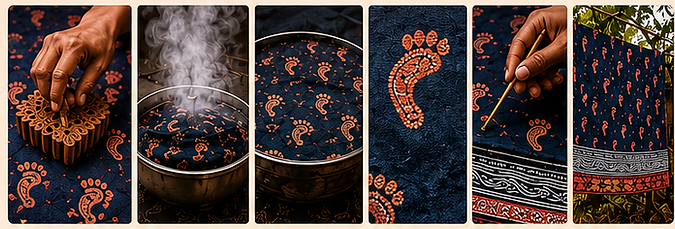
The Mahad Print is created using a discharge dye technique because of our dark blue base and lighter print.
It is a slow, careful and hit & trial process that demands patience, experience and unwavering belief.
BLOCK PRINTING
The discharge paste is carefully printed on the dark fabric using hand carved blocks.
STEAMING
COLOUR RELEASE
The printed fabric is steamed to activate the discharge paste.
The fabric is washed, and the colour begins to release, revealing the lighter print.
EVALUATION
We check if the right shade and clarity have appeared.
CORRECTIONS
If the colour is not right, we reapply. steam again and wash. This is a trial & error method.
DRYING
Once the perfect shade appears, the fabric is dried naturally, ready for next step.


From Memory
to Material.
Every Palm Print piece begins long before the fabric. It begins with research , with remembering, with stories that deserve to be seen. Through the hands of skilled artisans, these stories are carved, printed and brought to life one step, one block, one piece at a time.


RESEARCH & INSPIRATION
We explore archives, litrature, artwork, photographs and oral histories to discover stories that shaped our society.
CARVING THE STORY
Our artisans hand-carve each motif onto wood blocks with care and skill. Each line has a meaning. Each carve holds a memory.
PREPARING THE PRINT
Dyes are mixed mindfully. The block is inked by hand, ensuring even coverage and rich, lasting impressions.
HAND BLOCK PRINTING
Each block is placed and pressed by hand.
No machines, No shortcuts.
Just patience, precision and practice.
TRIAL AND ERROR. EVERY TIME.
_edited.png)
No two batches behave the same — temperature, humidity, water and timing all influence the result.
It takes experience, instinct and patience to get it right.
A DESIGN WE REFUSED TO REMOVE.
_edited.png)
Our print features feet — a symbol of thousands who walked to Mahad for water and dignity.
Designers advised against it.
“We don’t think it will look good on fabric.”
But this wasn’t just a design.
It was a story. A memory. A movement.
We believed that if fabric could carry the stories of kings and flowers, it could also carry the footprints of resistance.
We stayed persistent.
The feet remained.
And the story found its place.
THE STITCHING PROCESS
STEP-BY-STEP PRINTING PROCESS


DESIGN CHALLENGES WE OVERCOME
Before printing began, we were advised not to use the feet motif.
“It won’t look good on fabric,” we were told.
But for us, these footprints were not merely visual elements.
They represented the thousands who walked to Mahad demanding access to water, dignity and equal rights.
Removing them would mean removing the memory itself.
We believed that if textiles could carry the stories of kings, courts and victories, they could also carry the footprints of people who fought for equality.
So we stayed persistent.
The feet remained.
And slowly, through trial, craft and conviction, the story found its place on fabric.

FABRIC INSPECTION
PATTERN MAKING
CUTTING
STITCHING
PRESSING
PACKAGING
Discharge paste is prepared.
Block is printed with discharge paste.
Fabric is placed in steamer.
After steaming the colour starts to lift.
We check the shade after first steam.
If not the right shade, we re-print corrections.
Steamed again until the right shade appears.
Finally dried in shade to set print.
